
AFGHANISTAN REMEMBERED
by Jackie Jura
~ written in 1998 on occasion of USA bombing of Afghanistan and Sudan ~
Travelling in Afghanistan in the early '70s my impressions of the people were so strong that I believe I was struck to the heart and have carried a piece of that nation in my soul ever since.
The attitude of the people toward Westerners was different from that of any country I'd visited before or after in the overland route from Europe to Australia. They looked you straight in the eye and put their best foot forward to show their culture and country at its best. They took pride in showing the sights of their villages and cities and joyfully extended hospitality. It was as though they wanted us to understand how dedicated they were to preserving their lifestyle; that it wasn't by accident they lived as they did, but by choice. They weren't a people longing for modernization and envying our ability to travel and consume, as had been the case in Iran. They didn't wear the yoke of oppression, but on the contrary were determined to maintain their manner of living at any cost.
By the time I left Afghanistan I realized I had met a people who had an inborn sense of belonging to a culture that dated back centuries and for which they would fight to the death to preserve. I remembered them with tears and heartbreak when the Soviet Union invaded their country a few years after I'd left. Now the United States, with the complicity of the other major powers, has perpetrated an unprovoked attack on that sovereign nation, and I am once again suffering for the people of Afghanistan, and for the people of Sudan as well.
I entered Afghanistan by bus from Iran, arriving in Herat late at night. In extreme exhaustion from stomach cramps and dehydration, all I remember that night was being taken to a hotel room where I fell into a cot and slept like a rock. In the morning I heard the sound of horses' hooves and shouts. I looked out the window and saw turbaned men charging through the middle of the street on huge horses. It was like something out of the Arabian Nights!
Leaving my room I headed down the hall to the second-floor dining room where our entrance inspired indifferent glances from six or so Afghani men seated at a table eating their meal. They nodded at us but otherwise observed us from a distance. We saw what the people were eating and ordered the same. Our food came with no utensils and we got some smiles when we kept looking at the Afghanis to see how they ate. None of them used their left hand but instead pushed everything onto the flatbread held in their right hand, making it into a scoop. Not being as dexterous, we used bread in both hands for pushing. They must have thought we were infidels! After observing us for a while, they asked where we were from, repeating "KANADA" and smiling.
Going downstairs to the lobby and out onto the street I saw that our hotel was a three or four-story structure with a flat roof, something like the hotels one sees in the western movies only made of dried mud instead of wood. I saw a man climbing a ladder to the top of the roof. He had a pole across his shoulders and on each end dangled a large bucket. When he got to the roof he climbed a large cistern and poured water from the buckets into the cistern, then down the ladder he went and off again to fill the buckets from the water source. It dawned on me then that the shower I had enjoyed that morning had been possible from water delivered by the bucketful by manual labour. I've never felt comfortable leaving a tap running since and always try to get in and out of the shower quickly, remembering that in some countries a shower is a hard-earned luxury.
The street was packed-down dirt and very wide, and just up from the hotel was the hustle and bustle of the town centre. Both sides of the street were lined with stalls of merchants selling every imaginable ware. Trinkets and fabrics and leather goods and brass, silver and gold items were displayed and available for barter. Wherever you stopped you were handed a tiny glass teacup full of "chi" to drink while you bartered. I remember one of the most prized possessions I ever owned I bought there - a beautiful red jeweled and brass handled knife that folded out to cut bread and cheese and when not in use folded up and lived in my carpetbag purse - until at some future border it was seized under suspicions of being a weapon.
The streets were full of people dressed in long robes, including the men. The women were covered completely from head to toe, except for a screen across their eyes through which they could see out but we couldn't see in. They carried children with them and everyone seemed always in a hurry, going somewhere or coming back.
The streets were full of transportation - camels and horses and carts. The men had swords hanging off their robes, huge dark eyes, long beards and turbans. People noticed you but didn't interfere, just let you be in their midst. Along the way were teahouses where old men sat outside smoking hookas and drinking chi. Invited in behind the curtain the room was like a den or an igloo, with people sitting on dried mud benches appearing to be carved out of the wall and covered with carpets. They brought tea and asked questions about KANADA, everyone smiling and nodding when you looked at them.
The second morning in Herat I was hanging laundry on the roof when I heard children down below. Looking over I saw them all lined up with an adult speaking English phrases and the children repeating them. They were learning sentences like, "Where do you come from? - How long are you staying? - Can I show you the way? and - Would you like me to take you?" Upon seeing me they wasted no time putting their lessons into practice and for the duration of my stay followed me everywhere and eventually took me to places I would never have known about without them. I felt like the Pied Piper.
One time when we were on the outskirts of town a man came up to me and spoke perfect English. He had studied in the United States and had come back to help build his country. He invited me into his home to meet his mother, wife and children. Inside the home the women were not covered and I saw my first Afghani woman's face. We ate oranges and talked about Afghanistan.
Leaving Herat for Kandahar and then on to Kabul I left a piece of my heart with the children who had spent so much time with me. It is them I cry about when I think about what the Afghani people went through defending themselves from Godless tyranny. I imagine some of them were by then just old enough to be handed a gun or a grenade. Instead of living their lives in freedom and sharing their country with travellers they were leaving their schoolrooms to learn geurilla warfare with the men.
I knew when the war started that the Soviets would never beat the Afghanis because I'd met the people and no prouder or stronger people exists on the planet. The cost was incredible with millions dying in the ten years it took to send the Soviets into retreat.
I cry as well for the destruction of the land through bombs and for the atrocity of the landmines left by the Soviets to maime the survivors of the battle against evil - which is what they were fighting when they fought the communists. I'll never forget, as I travelled across the country, the sight of the distant caravans, miles of camels carrying the tents and possessions of nomads as they moved across the land. That entire way of life was destroyed by the Soviets as they bombed and rode over the nation with tanks.
~ Afghanistan Remembered by Jackie Jura ~

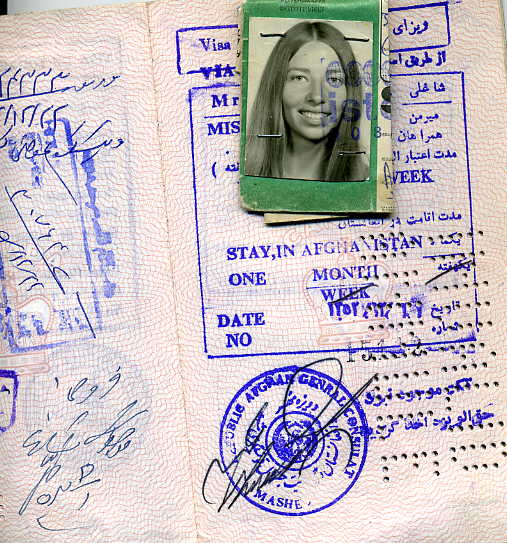
~ Afghan visa stamped in passport;
bus breakdown in Khyber Pass between Afghanistan and Pakistan with friends met on overland journey;
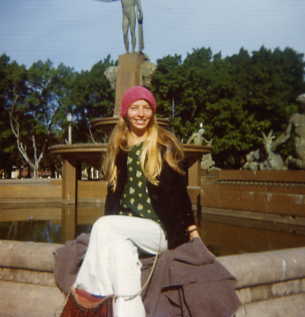
wearing Afghan blouse with carpetbag purse in a park in Australia;
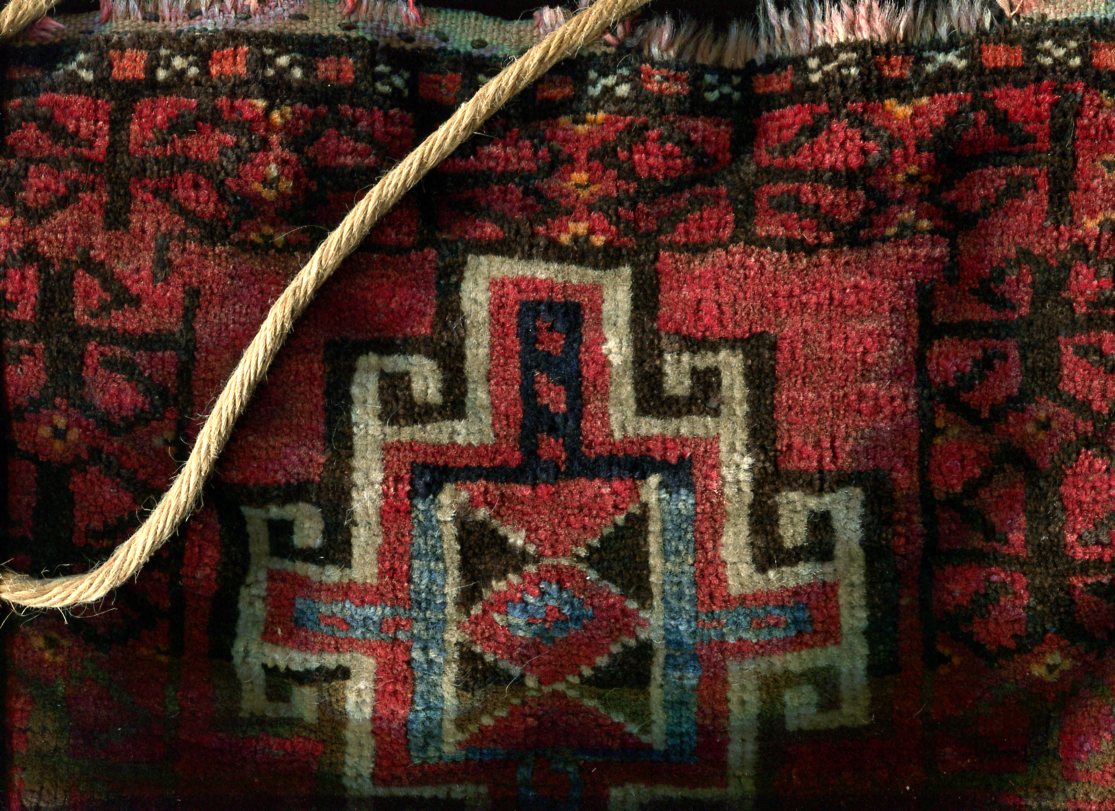
scan of Afghan carpetbag purse which hangs in my office today
See also IN AFGHAN FIELDS and NEPAL REMEMBERED
PS -- Today, in the news for Remembrance Day 2018 I once again have Herat in my heart from when I travelled through Afghanistan in the early 70s and wrote the above essay AFGHANISTAN REMEMBERED about the time I spent in Herat. That was a few years before the Soviet Union invaded Afghanistan and now, these past 20 years, we in the Western World have joined with the Communists in bombing Afghanistan. Now the ONE WORLD GOVERNMENT (BIG BROTHER) -- ie the UNITED NATIONS (backed by Russia, China, Britain, USA, Europe, Israel etc) -- is in Afghanistan running the global heroin and aid rackets making trillions of dollars destroying billions of lives all over the world. As Orwell said in 1984, "Big Brother is a dedicated sect doing evil."

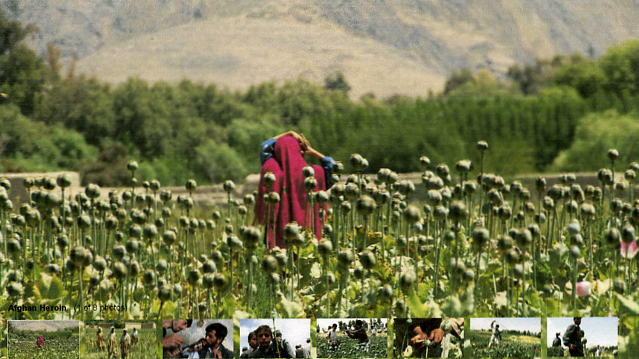
Afghanistan, once a breadbasket, is now a starving basket case growing opium poppies instead of wheat. Here's from an article I wrote in 2004:
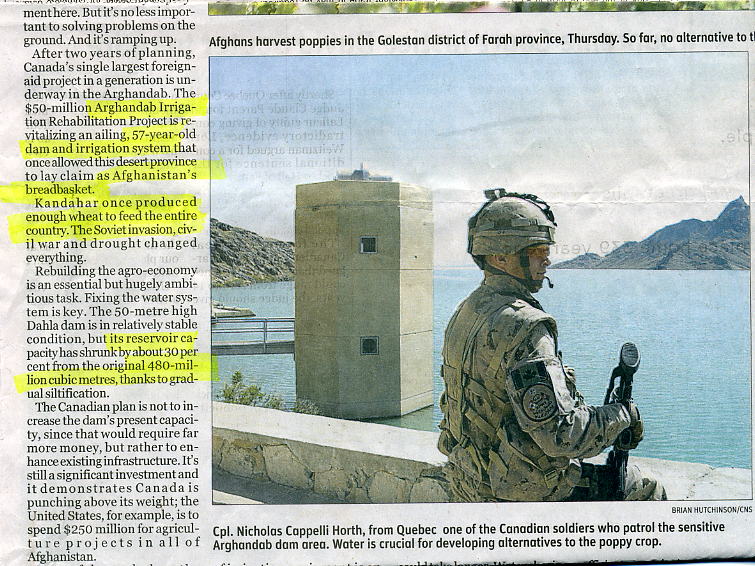
After two years of planning, Canada's single largest foreign-aid project in a generation is underway [2004]. The $50-million Arghandab Irrigation Rehabilitation Project is revitalizing an ailing 57-yr-old dam and irrigation system that once allowed this desert province to lay claim as Afghanistan's breadbasket. Kandahar once produced enough wheat to feed the entire country. The Soviet invasion, civil war and drought changed all that... See CANADA SELLING AFGHAN'S WATER
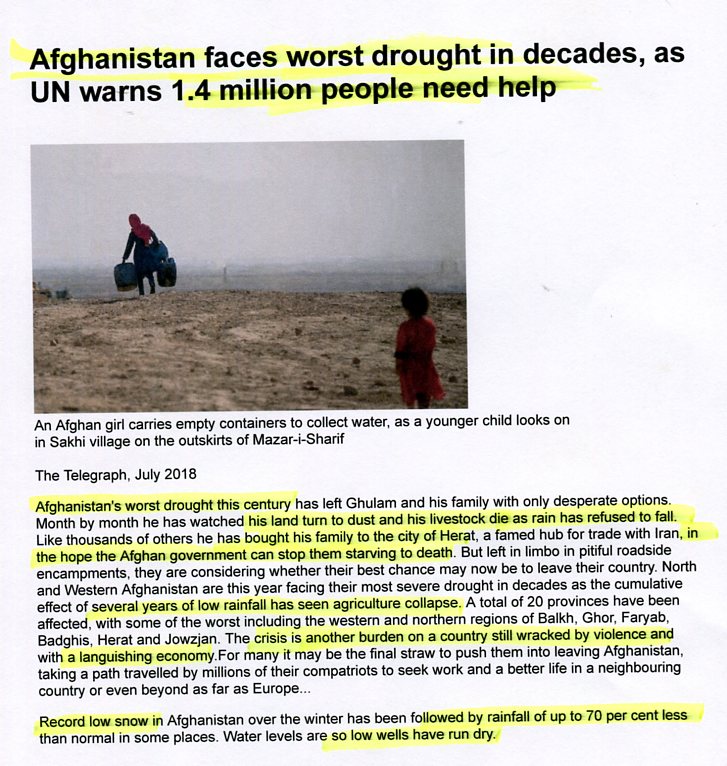
 Displaced victims of worst Afghan drought in years fear harsh winter, Reuters, Nov 8, 2018
HERAT, Afghanistan -- Mahiuddin, a 35 year-old farmer from Badghis, a mountainous province in western Afghanistan, has been living in a camp outside the city of Herat for months, one of tens of thousands displaced by the worst drought the country has seen in years. For all the billions of dollars spent since the Taliban were ousted in 2001, Afghanistan remains a desperately poor country, lacking basic infrastructure, including electricity and paved roads across most of its territory. Struggling after decades of war, Afghanistan is now facing an acute food shortage in many regions, with 2.6 million people enduring emergency-level food insecurity, one stage short of outright famine, according to the U.N. Food and Agriculture Organization. Aid groups provide emergency assistance of 6,000 afghani (US-$80) for immediate needs as well as help with cooking equipment, tents, tarpaulins and fuel but the thousands camped out in settlements are looking forward with apprehension to the harsh winter months ahead. "The tent is so cold and I have two small children", said Abdul Wakil from the northern province of Faryab, who arrived four months ago at a camp outside Herat. "I turn to one side to warm up and then turn to warm the other". Already the U.N. Office for the Coordination of Humanitarian Affairs (OCHA) has reported the first deaths among displaced children because of the cold in Herat and Badghis. Officials say relief efforts have been hampered by a lack of coordination between central and local government and aid organizations, with displaced people spread out over 10 main camps and dozens of smaller settlements around Herat. "A lot of people have been displaced and all of them are needy", said Ahmad Jawid Nadem, head of the local department of refugees and repatriation, who said resources had been badly strained by the thousands of arrivals. "Our food stocks are empty and we have asked the central government to provide us assistance. Once we receive help from central government, we will distribute food to displaced people", he said...
Corrupt UN & World Bank waste billions in aid to Afghanistan,GlobeMail, Nov 8, 2018
The USA Special Inspector-General for Afghanistan Reconstruction said in a report to Congress that aid money has gone to build medical clinics without electricity or water, schools without children and buildings that literally melted away in the rain. Also, corrupt local officials who were in charge of paying workers with some of the funds created what the audits called "ghost workers", civilian bureaucrats, police and soldiers who did not exist, then kept or diverted money recorded as being paid to them... Nearly 2,400 U.S. soldiers have been killed fighting the Taliban, and 158 Canadians died before Canada pulled its combat troops out of Afghanistan in July, 2011. The Afghan government is still fighting intense battles across most of the country and millions of Afghans have been displaced. As the country became increasingly dangerous, Western countries pooled their aid dollars into trust funds managed by the World Bank, the United Nations and the North Atlantic Treaty Organization. The recent reports by Mr Sopko's office found a troubling lack of financial oversight and far-reaching mismanagement of two Western trust funds -- the World Bank's Afghanistan Reconstruction Trust Fund and the UN-administered Law and Order Trust Fund for Afghanistan, used to train and equip Afghan security forces.
According to the Library of Parliament, Canada has donated more than $3-billion in foreign aid to Afghanistan since 2002, including US-$851-million, to the two funds. The United States is the largest donor to the two funds. Canadian contributions include US-$764-million to Afghanistan reconstruction from 2002-2018, and US-$87-million to train Afghan police. Another US-$213-million went to a NATO fund to train the Afghan army. He said local officials questioned the usefulness of some of the programs that were funded...
'Unprecedented' surge in cheap, high-purity heroin expected from Afghanistan, Telegraph, May 2, 2018
Afghanistan's farmers grew more than 1,250 square miles of opium poppy last year, paving the way for potentially unseen levels of heroin production. The bumper crop has the potential to make up to 900 tonnes of high purity, export quality heroin the UN's Office on Drugs and Crime said. Afghan opium already provides more than 90 per cent of the world's heroin and 95 per cent of that found on Britain's streets... Opium now dwarfs all other sectors of the Afghan economy, despite a 17-year-long international aid campaign to try to rebuild the country after the Taliban regime was toppled in 2001. The crop was worth up to 5-billion pounds, or nearly a third of the country's entire GDP, while legal exports are worth only around seven per cent. Many billions more are made further down the drugs pipeline, as it is smuggled across the Middle East into Europe. Impoverished farmers are now increasingly reliant on the crop, and it is now the backbone of Afghan agriculture, making efforts to curb the trade harder...
IN AFGHAN FIELDS HEROIN GROWS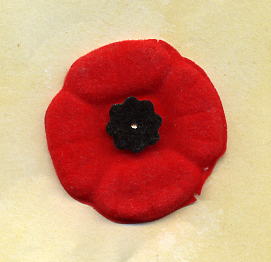
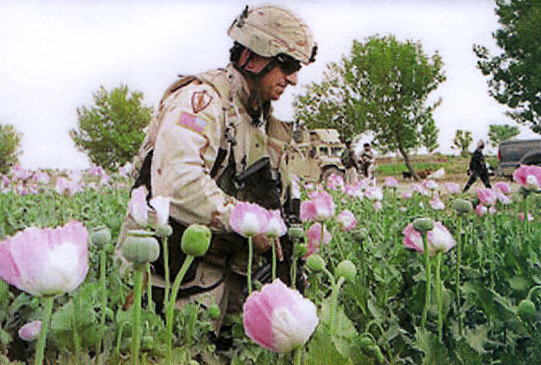
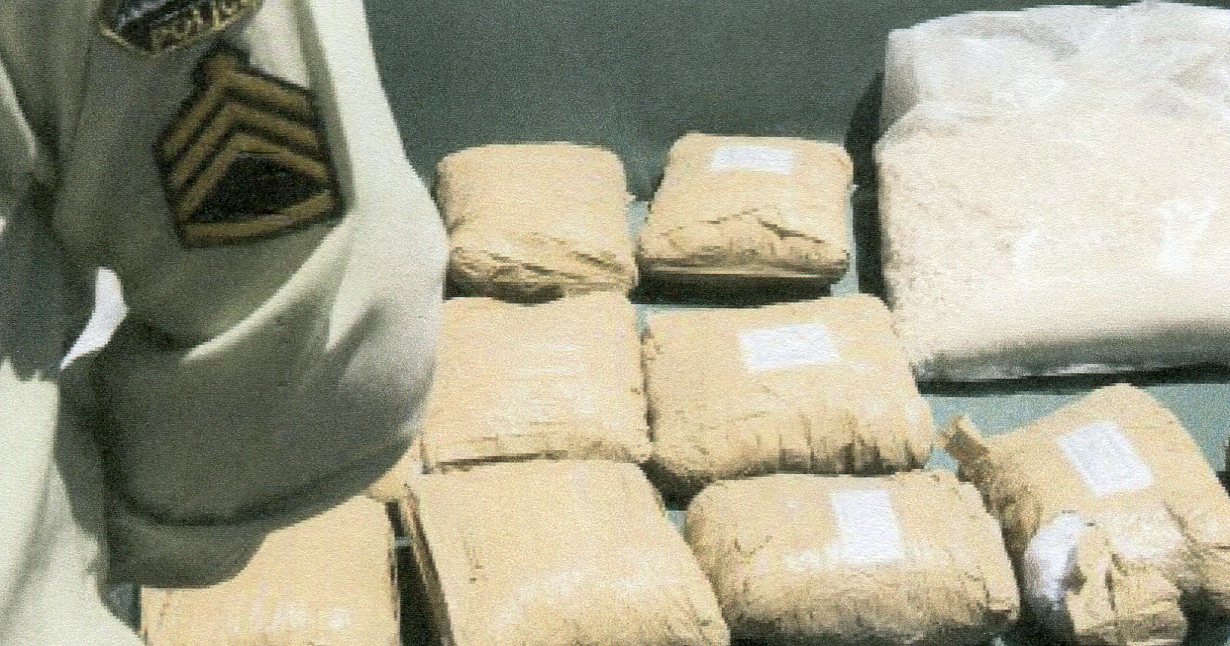
900-tonnes Afghan heroin hitting world streets

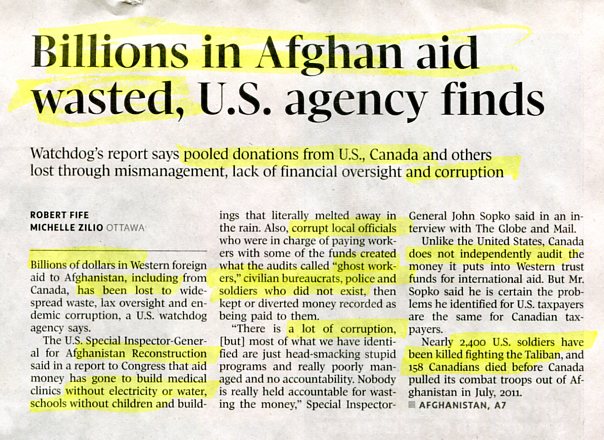
Corrupt UN-World Bank steal billions Afghan aid
Telegraph/Globe, Nov 11, 2018
ORWELLIAN WAR BY DRUGS
Afghan worst drought in history starving millions
watch UN crooks ask $-millions for Afghan drought
Telegraph/YouTube, Nov 11, 2018
AFGHANISTAN REMEMBERED
& Big Brother United Nations a sect doing evil
IN AFGHAN FIELDS
Afghan heroin flooding Europe/USA/CAN/UK/OZ/NZ
(despite tax-funded US$20-billion to counter-narcotics)
Heroin use on rise -- Poppy crops thrive
NBC/DailyCaller, Nov 11, 2015
ORWELLIAN WAR BY DRUGS
& Ministry of Peace (War) & BB Brotherhood
Afghanistan Set Record for Growing Opium in 2014, CNS News, Jan 6, 2015
After thirteen years of occupation by USA forces, Afghanistan set a record for growing opium poppies in 2014, according to data from the United Nations Office on Drugs and Crime (UNODC). Heroin is derived from the poppy. A UNODC report -- "Afghanistan Opium Survey 2014" -- provides a "detailed picture of the outcome of the current year's opium season and, together with data from previous years, enable the identification of medium -- and long-term trends in the evolution of the illicit drug problem". "The total area under opium poppy cultivation in Afghanistan was estimated to be 224,000 hectares in 2014, a 7% increase from the previous year", says the report. Net opium poppy cultivation in Afghanistan grew from 209,000 hectares in 2013 to 224,000 hectares in 2014. The UNODC has been tracking opium cultivation in Afghanistan since 1994, when net Afghan opium production was 71,000 hectares. The 2014 cultivation of 224,000 hectares was more then triple the 1994 level. According to the 2014 World Drug Report, also published by the UNODC, Afghanistan by far the world's largest producer of opium. "The opium production in Afghanistan accounts for 80 percent of the global opium production (5,500 tons)", said that report.... Most of the U.S. casualties in Afghan War have occurred in the Hilmand and Kandahar provinces, which are also the two leading opium-growing provinces. According to CNSNews.com's database of USA casualties, from 2001 through 2014, 2,232 USA military personnel gave their lives serving in the Afghan War. Of those 2,232 casualties, 451 were in Hilmand province and 420 were in Kandahar. That represents 39 percent of the total casualties in the war. "There is evidence that Afghan heroin is increasingly reaching new markets, such as Oceania and Southeast Asia, that had been traditionally supplied from Southeast Asia", the report states.
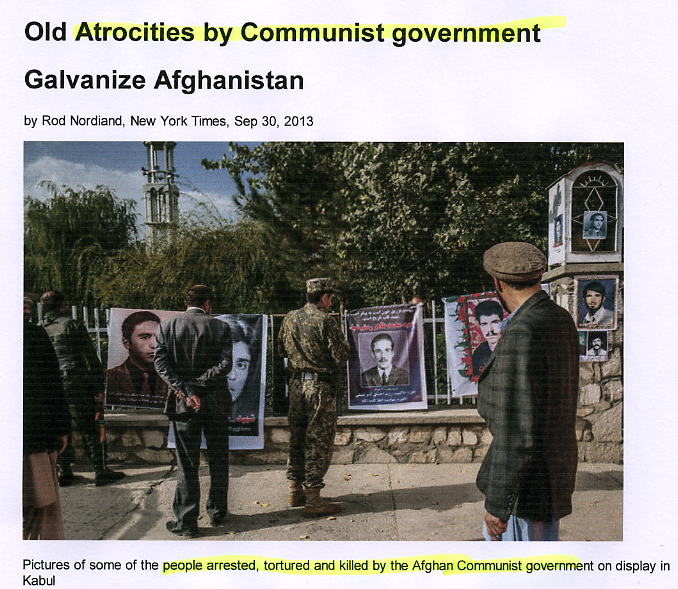 Old Atrocities by Communist government galvanize Afghanistan, NewYorkTimes, Sep 30, 2013
KABUL, Afghanistan -- So many people were buried alive by bulldozers in the barren fields around the Pul-e-Charkhi Prison on Kabul's outskirts that guilty soldiers later said it was like an earthquake as their victims tried to claw their way out. Thirty-four years later, the names and details of nearly 5,000 of those victims -- arrested, tortured and killed by the Afghan Communist government in 1978 and 1979 — have resurfaced, cataloged in records released in September. The so-called death lists were originally compiled by the Afghan government. They languished, unreleased, for decades, until unearthed by Dutch investigators and published on the Web site of the Netherlands national prosecutor's office. The Afghan government's reaction to the release of the lists was initially cautious, and President Hamid Karzai was quoted as saying that reconciliation was more important than prosecutions. It is a sensitive issue in Afghanistan, and not just because so many former Communist officials now hold high positions in government, especially in the military and police hierarchies....
The chain of events that led to the lists' discovery began with an asylum request by Amanullah Osman, the head of interrogation for Afghan intelligence in 1978 and 1979, who fled to the Netherlands in 1993. In his asylum interview, according to the prosecutor's office, Mr. Osman admitted to signing documents concerning people who were to be executed. "That was expected and desired of me", he said. "If you don't go along with it, you can never attain such a high position".... The Dutch denied him asylum but never expelled him, and eventually opened up a war crimes investigation. That led them to a 93-year-old Afghan refugee in Germany who gave them the death lists, which she had gotten from a former United Nations official, Felix Ermacora, who had never released them. Dutch authorities said they were confident of the lists' authenticity....
China leading in Afghan resources: adds oil to copper, Business Week, Sep 13, 2011
China National Petroleum Corp. offered the highest royalty and a refinery to win Afghanistan's first oilfield auction last month, using a strategy that helped Chinese companies gain access to African resources. CNPC will pay 15 percent royalty on oil from three blocks in northern Afghanistan and 30 percent corporate tax and also build a refinery, Abdul Jalil Jumriany, policy director at the mines ministry in Kabul, said by e-mail. Australia's Buccaneer Energy Ltd. proposed 10 percent royalty and was second, he said. The deal, to be completed in a month, will boost China's position as its neighbor's biggest foreign investor after a state company [Communist China goverenment] won the right in 2007 to mine the biggest copper deposit in Afghanistan by pledging to build a coal mine, power plant, smelter and railroad. In Africa, producer of 12 percent of the world's crude, Chinese companies promised billions of dollars in aid, investment and loans for energy supplies. "China is certainly seeking resource security, but its motives are broader", Deborah Brautigam, a Washington-based scholar and author on Chinese-African relations, said in a Sept 9 telephone interview. China's state-owned companies are likely pursuing Afghan deals "for commercial, strategic, political and resource-security reasons all combined". Three calls to CNPC's public relations department in Beijing went unanswered. Mao Zefeng, a spokesman at unit PetroChina Co., declined to comment when reached by telephone. President Hamid Karzai's cabinet late last month approved the mines ministry's decision to allow CNPC to drill for oil in three blocks of the Amu Darya basin, a geological zone that extends into Turkmenistan and Uzbekistan. While CNPC's oil deal, for blocks that hold an estimated 80 million barrels, is relatively small, its win may give the company an advantage in chasing bigger Afghan reserves. The Afghan-Tajik Basin, a geological zone in the northeast, is estimated to hold 1.9 billion barrels of undiscovered oil and natural-gas liquids along with gas deposits equivalent to 1.5 billion barrels of oil, based on U.S. Geological Survey data. The government will hold its next oilfield auction in the area in February, Jumriany said...
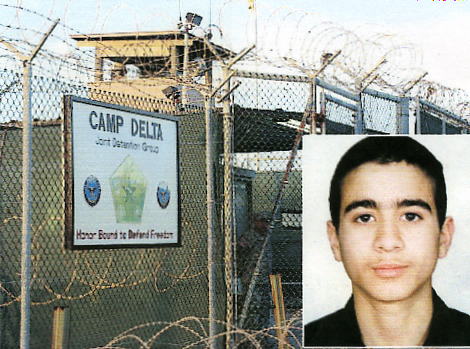

 STALIN PROUD OF KHADR SHOW TRIAL
Stalin would be proud of Khadr show trial (Afghan-Canadian confessed after torture) & USA sentence Khadr to 40 years prison (pled guilty to 5 war crimes when 15-yrs-old). National Post, Nov 1, 2010. Go to Destruction & Torture & Interrogation
 Khadr photos show he's innocent: lawyers. CBC, Oct 29, 2009
The former defence lawyers for Omar Khadr are reported to have submitted photos and documents they say could show he did not kill a U.S. soldier in Afghanistan. The Toronto Star reported Thursday that the photos were submitted earlier this year by Khadr's formerly military defence team to a U.S. government task force looking into the detainee camp at Guantanamo Bay, Cuba. Khadr, now 22, is accused by the United States of killing a U.S. soldier with a hand grenade in Afghanistan in 2002, when he was 15. He has been held at Guantanamo Bay since then. The newspaper said the photos it obtained show an injured Khadr under rubble from a collapsed roof. Beside Khadr lies a dead militant apparently killed by U.S. forces. Khadr's former defence team contends that the dead man lying beside him in the photo may have thrown the grenade that killed Sgt. Christopher Speer. The case against Khadr at the U.S. military tribunal in Guantanamo is adjourned until Nov. 16 while U.S. President Barack Obama decides how to proceed with Khadr and roughly 200 other prisoners there. Obama has vowed to shut down the controversial prison at the military base in Cuba.
Brtish troops relying on Russian supply aircraft. Daily Mail, Jul 19, 2009
USA Afghan strike kills 100 civilians (70,000 foreign troops/21,000 more pledged). AFP, May 6, 2009. Go to IRAQ AFGHANI PHONY WARS & AFGHAN NARCO-STATE NOW & DRUG WAR IS PEACE & AFGHAN KIDS DIG SOVIET BOMBS
Russia warns of Afghan parallels. BBC, Feb 14, 2009
Russia says ready to work with USA on Afghanistan. Reuters, Jan 23, 2009
Afghanistan a broken nation (one of 5 worst places on earth). National Post,, Oct 22, 2008
NATO troops killing Afghan civilians (excessive force & dropping bombs; UN failing to deliver food & aid). GlobeMail, Jun 29, 2008
Afghan overtaking Iraq in terror war (takes more money & resources). AFP, Jun 19, 2008. Go to IRAQ AFGHANI PHONY WARS & 28.Reality Control & 36.Hate Week & 22.MiniPeace & 11.MiniPlenty
Canada delves into Foreign Affairs affair (Minister left Top-Secret documents in Mafia-linked girlfriend's bedroom) & Top-Secret documents found on UK train (has familiar ring to Canada) & New Foreign Affairs Minister at conference (UN/NATO/WB/IMF support Afghan war). CanWestNews, Jun 13, 2008. Go to FOREIGN AFFAIRS MUSICAL CHAIRS & 5.Pyramidal NWO
Billions in Afghan aid money wasted (on foreign salaries-housing-security). AlJazeera, Mar 26, 2008
Canada Afghan war double over budget (cost taxpayers $8-billion since 2001). CTV, Mar 18, 2008. Go to AFGHAN NARCO STATE NOW & Top Iraq contractor skirts USA taxes (was top Vietnam contractor too; & Yugoslavia-Afghan-Africa wars) & Box 13 ballots put Johnson in Senate (with nickname "Landslide Lyndon"). Boston/DallasNews, Mar 17, 2008. Go to 11.Ministry of Plenty & LBJ OF ELMS ON ELM & LBJ AIR FORCE 2 TO 1
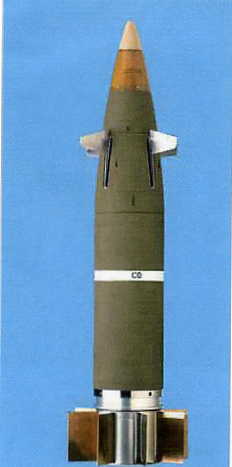
Canada firing GPS bombs on Afghans (each bullet costs $150,000). CBC, Mar 26, 2008
Canada Afghan war double over budget (cost taxpayers $8-billion since 2001). CTV, Mar 18, 2008
Afghan $100-million bottled water market ("unexpected opportunities of war"). Financial Post, Feb 25, 2008. Go to AFGHAN WAR WATER-PROFITEERS
Extreme snow & cold cover Afghanistan (millions of people & livestock suffering) & Weather & war overwhelm Afghans (NGOs won't help until they assess). BBC/WashPost, Feb 13, 2008
Afghanistan appeals for food aid. BBC, Jan 4, 2008
...Afghanistan does not grow enough wheat to feed all its people and is partially dependent on imports... "The situation is serious," he said. Kabul has come under increasing pressure to take action, amid rising grain prices on the international market. And the political crisis triggered by the assassination of Pakistani opposition leader Benazir Bhutto has led to a reduction in wheat shipments from Pakistan. Some people also blame shortages on the fact that wheat is being smuggled out of Afghanistan to neighbouring Tajikistan. In some areas, the price of bread has doubled or even quadrupled. "Food prices have gone up and no-one can afford to buy all the food they need," said a resident of Lashkar Gar, the capital of the southern Helmand province. "A 100kg of flour is about 3,300 Afghanis ($67), and poor people will not be able to afford to pay this at all. The government should do something about it," he added. Helmand is one of the worst-affected areas - some say partly because local farmers have increasingly switched from growing wheat to the more lucrative opium poppy....
BENAZIR BHUTTO ON AFGHANISTAN ('beautiful nation & lovely people'). GlobeMail, Dec 31, 2007
Omar Khadr: The Youngest Terrorist? (Was Only 15 Years Old When He Was Captured In Afghanistan). CBS News, Nov 18, 2007
Harsh winter: Afghans struggle for survival (choice between wood/bread; freeze/starve). Washington Post, Feb 18, 2007
International aid neglects Afghan hospitals (CIDA admits none of its $100-million has been spent on medical care). Canada.com, Feb 18, 2007
Afghan heroin flooding USA (the purest in the world causing seizures & overdoses). PakistanTrib, Jan 1, 2007
Afghan kids scavenge for explosives (left by retreating Soviet army) & Canada's new Afghan offensive ("Operation Bazooka" for Taliban). NationalPost, Dec 16, 2006
Afghan poppy harvest at record level (cheap heroin for UK streets) & Police want heroin injection sites (5,000 users in downtown Vancouver). Times/CBC, Aug 19, 2006
Heroin fields' grim reapers (opium growing has increased tenfold) & Brain pills for all urges UK gov't scientist. Sun/Times, Jun 7, 2006
Reader asks how to create a learning experience for a boy who chose the poem IN AFGHAN FIELDS as his own
Afghan gripped by worst fighting since 2001 (in main opium-growing region & western city of Herat). Independent, May 21, 2006. Go to 35.Brotherhood & 5.Pyramidal NWO
Canada boy tortured 4-yrs by USA (Guantanamo prison for aiding Afghans). CTV, Mar 9, 2006. Go to 34.Ministry of Love (Torture) & 39.Interrogation & Torture & GUANTANAMERA NOW GUANTANAMO BAY
USSR's foreign minister advises Canada (to continue war in Afghanistan) & Canada gives war decision to General (no parliament vote or people consent). Canada.com/CBC, Mar 7, 2006. Go to WHERE'S THE ENEMY'S ARMY? & IRAQ A MAGICIAN'S TRICK & THE MILITARY ARE MAD
Heroin trade thrives in Iraq (non-existent under Saddam's rule). Telegraph, Sep 4, 2005. Go to IN AFGHAN FIELDS
Popular Afghan singer killed in Vancouver, CBC News, May 10, 2005
Police say popular Afghan singer Nasrat Parsa is dead following an attack over the weekend outside his hotel in East Vancouver....Three men approached Parsa after a concert on Saturday night. He said witnesses saw one man punch Parsa, who then fell backwards on some concrete stairs. The 36-year-old Parsa was taken to Vancouver General Hospital, where he died on Sunday night. A 19-year-old man was arrested and initially charged with aggravated assault. Police have recommended that the charge be upgraded to manslaughter. Parsa lived in Germany, and was popular among young Afghans around the world after recording 10 albums. He had performed a concert in Toronto last week before going to Vancouver.
Fears for children in Afghan cold (28,000 people at risk). BBC, Feb 18, 2005
Profile: Ismail Khan. BBC, Sep 13, 2004
Ismail Khan became one of the most powerful men in Afghanistan. Until sacked by President Hamid Karzai he governed Herat, a city unlike any other in Afghanistan. In Herat, correspondents say, the streets are clean and orderly, and there are traffic lights that drivers actually obey. During Mr Khan's rule the city flourished, and Herati women are among the country's most educated. He was an officer in the national army and began fighting Soviet forces stationed in Herat just months after their arrival in 1979.He became a mujahideen commander and fought the Soviets until their withdrawal a decade later. Eventually, he took control of Herat, where he ruled until imprisoned by the Taleban when they swept to power in 1995. His escape from his captors in March 2000 allowed him to join the Northern Alliance and fight to end five years of strict Taleban rule in Afghanistan, earning him the gratitude of Herat's population. His face appears on posters all over the city - part of a personality cult he created around himself...Mr Khan's removal is part of Mr Karzai's effort to rein in Afghanistan's warlords.
Big Brother disarms Afghan heroes (militia fought Soviets & Taliban). Baltimore Sun, Jul 12, 2004. Go to 6.Super-States & 7.Systems
Reader asks about Afghanistan, Iraq & USA presidency
Son of Afghan hero killed (Herat loves leader Ismail Khan for resisting Soviets & Taliban) & Heroin poppy threatens Afghanistan (thriving under UN control). BBC, Mar 22, 2004. Go to 6.Super-States & 35.Brotherhood & AFGHAN FIELDS
TROOPS BREATHING FECAL MATTER (military to test Kabul's air quality). Ottawa Citizen, Jan 4, 2003. Go to BIO/CHEM WARFARE
Soldiers playing Santa in Afghanistan (hand out shoe boxes of trinkets to destitute of war-ravaged nation). Canoe.com, Dec 20, 2003
3,000 troops to Afghanistan & Bosnia (to fight non-existent enemy). National Post, Jun 28, 2003. Go to 12.Ministry of Peace (War) & ARMY TO AFGHANISTAN & BOSNIA?
Afghanistan world's biggest heroin dealer (poppies springing up everywhere in midst of Western armies). Independent, Jun 22, 2003. Go to OPIUM WARS WITHIN
2,000 CAN troops to Afghanistan (without public or gov't approval). National Post, May 30, 2003. Go to 4.Old World Destruction & 11.Ministry of Peace
USA B-52s bomb Afghan targets (drop seven 2,000-pound bombs). BBC, Dec 2, 2002. Go to 6.Disputed Territories & 12.Minipax
1980 Soviet Grain Embargo (after Russia attacked Afghanistan). AgWeb, Oct 31, 2002. Go to FEEDING FREEDOM'S FOES (instead of grain embargo to Russia)
IN AFGHAN FIELDS, poem by Jackie Jura
Afghan opium at record levels. Rense.com, Sep 17, 2002. Go to DRUG WAR & PEACE
Afghan valley yields bitter crop (farmers yearn for land laid waste by war). Toronto Star, Mar 4, 2002
AFGHANISTAN AFTERMATH and NEPAL REMEMBERED
Jackie Jura
~ an independent researcher monitoring local, national and international events ~
email: orwelltoday@gmail.com
HOME PAGE
website: www.orwelltoday.com
