
Lennon's dark fate is
entrapment by a woman who stalks him for months,
desperate to exploit his celebrity and his millions.
Yoko Ono is a she-wolf dressed in black and
such a core of negativity that
she sucked the air out of the room....
LENNON'S DARK FATE ONO
Did Yoko do her hypnotism thing or
did she have a powerful new drug in her arsenal?
It must have been something pretty potent
that made John fall headlong into a mad obsession.
Overnight he no longer had a will of his own.
Shortly after this John started using heroin,
to which Yoko had introduced him.

Magical Mystery Tours: My Life With The Beatles
by Tony Bramwell with Rosemary Kingsland
book review by Peter Feniak:
1968. John Lennon, recently inspired by LSD, calls an emergency meeting of the Beatles at their Apple headquarters in London. "I've got something very important to tell you," Lennon says. "I am Jesus Christ. I have come back again. This is my thing." "Right," responds Ringo Starr, well-used to the eccentricities of this brilliant Beatle. "Meeting adjourned. Let's go have some lunch." At the restaurant, Lennon, unbowed, is approached by a fan eager to meet John. "Actually, I'm Jesus Christ," he insists. "Well," replies the fan, "I still liked your last record."
Tony Bramwell, long-time associate of the "four lads who shook the world," brings a wealth of such anecdote to Magical Mystery Tours, a sprawling, amiable account of life near the world's most famous and most gifted pop group. Bramwell also reminds us that the real Beatles story is far more interesting than the cloying myth of "four lovable moptops" that still clings to them today.
The Liverpool that made them was a tough seaside town, postwar bleak, largely Irish-Catholic (like Lennon and McCartney), where outdoor toilets were still common, a telephone a rare luxury and television was BBC from 6 each evening until signoff at 9, when primitive sets threatened to overheat. "Britain was severely monotone," Bramwell writes. "English movies were austere kitchen-sink dramas. Clothes were drab. You weren't supposed to enjoy yourself." Something irrepressible would change that. Liverpool was also music-mad. The Silver Beetles (named in homage to Buddy Holly's Crickets) were a top local "beat group" when they left for a lengthy residency in the seedy clubs of Hamburg. When they returned as the Beatles, bonded by months of squalid living, easy sex and nightlong amphetamine-driven performances, no one could top them -- anywhere.
Bramwell's story begins on Liverpool's Number 81 double-decker bus as he finds childhood friend George Harrison is part of the "direct from Hamburg" group playing that night. Carrying George's guitar into the hall for free admission, Bramwell is hooked on the hard-driving, good-humoured and charismatic group. "In a year, I went to about 300 Beatles gigs, from one end of the Mersey to another," he writes. "I never stopped." As Bramwell moves from roadie to aide for Beatles manager Brian Epstein, Magical Mystery Tours follows the group's dizzying climb to world pop domination, then witnesses its ultimate crash at Apple Corp. -- the chaotic money pit the Beatles created to run their business following Epstein's untimely death.
Though initially "George's mate," Bramwell tells us more about Lennon and McCartney, with whom he often shares a pint and thoughts of home. Harrison retreats under the barrage of unprecedented fame to become a rural recluse, floating into Eastern music and mysticism. Ringo Starr, older and more fun-loving, enters the champagne life of movie stars and posh clubs. Lennon and McCartney walk different paths. Both are driven, incredibly gifted and haunted by their mothers' deaths. McCartney's beloved "Mother Mary" died of breast cancer when Paul was 14. Lennon, abandoned by both parents and raised strictly by "Aunt Mimi," ultimately discovers his mother, Julia, remarried and living nearby. "No sooner was John getting to know his mother" Bramwell writes, "when, in the summer of 1958, she was run over and killed yards away from Mimi's house by a speeding policeman who was late for work." For weeks after, friends recall seeing the brash rocker alone with a "thousand-yard stare."
Tony Bramwell seems to enjoy Swinging Sixties London more than his famous bosses, who can hardly move without pursuit by their "army of besotted fans." But he also bears witness to the "powerful . . . anger, hate and jealousy . . . that surged around them" as their bond cracks under the strain. Ultimately, McCartney flees London with poised hippy socialite Linda Eastman for a simpler life in Scotland.
Lennon's dark fate, in Bramwell's view, is entrapment by a woman who stalks him for months, desperate to exploit his celebrity and his millions. Yoko Ono finds little favour in Magical Mystery Tours -- described as "a she-wolf dressed in black," "a pain in the ass" and "such a core of negativity that she sucked the air out of the room." Ono is also credited with destroying Lennon's will, banning his lifelong friends and getting him hooked on heroin.
The portrait of Brian Epstein, the posh Liverpudlian who takes on the Beatles' career as manager and succeeds in historic dimension, is poignant. As the group becomes England's top attraction, then the world's, the gentle Epstein lives in torment, devoured by self-doubt, paranoia, amphetamine addiction and the anguish of homosexuality at a time when discovery still means jail. There is plenty of colour in Bramwell's tales of the post-Epstein Apple Corp., where frauds like Magic Alex squander thousands of Beatle pounds on whims, and where Yoko Ono daily takes delivery of beluga caviar from Harrod's.
Magical Mystery Tours also points out the sad reality that the Beatles were robbed blind. Neither Epstein nor the group understood the value of publishing, and sold the rights to their early songs for next to nothing. They also kept only a small fraction of their merchandising rights, enriching faceless businesses to the tune of £100-million.
"Looking back," Bramwell writes, "the Beatles triggered a massive social and sexual revolution." That revolution is better dealt with elsewhere. So is the Beatles' music, though Bramwell's memories of riding in the van between gigs as John and Paul jotted down million-selling song ideas ("It came easily to them") or practised the harmonies in She Loves You have their charm.
Ultimately, though, this is an unpretentious, homespun look back and a welcome addition to Beatles lore. They were kids when they began. They lived with remarkable intensity for a time. "It seemed that one minute I was young," Bramwell recalls wistfully, "the next, we were confronting our mortality".
[http://www.theglobeandmail.com/servlet/ArticleNews/TPStory/LAC/20050521/BKBEAT21/TPEntertainment/Books]
MAGICAL MYSTERY TOURS: MY LIFE WITH THE BEATLES
by Tony Bramwell, chapter 24, pages 261-263


...That night at Kenwood, John and Pete hung out, took the usual drugs, gazed into space and did very little. Suddenly, John said he "fancied a woman." He picked up the phone and called Yoko, telling her to hop in a taxi, he'd pay. Yoko immediately hightailed it out to Weybridge. At first, she appeared shy and modest. She sat with downcast eyes and mumbled scraps of her poetry. Pete made his excuses and went to bed. What happened that night can only be left to the imagination, but since it patently wasn't the coming together of two vigins for the very first time, did Yoko do her hypnotism thing, as some of John's friends thought she had, or did she have a powerful new drug in her arsenal? Nobody really believed that John fell in love overnight, because why hadn't he done so before? He'd been kicking Yoko in and out of his life for over a year. Mostly, he had given the impression that he resented and despised her. So it must have been something pretty potent that made John fall headlong out of his casual affair with her into a mad obsession....Overnight he no longer had a will of his own.... It was hardly surprising that everyone was confused by the way in which John did a complete somersault and fell madly in love with her almost to the point of obsession....Shortly after this John started using heroin, to which Yoko had introduced him....
LENNON MUSIC DIED 45 YEARS AGO
Murder staged December 8, 1980-2025
 Life After Death
John's not dead: he's held captive by abductors


The Dream Is Over
 Ono: Yes, I'm A Witch: Princes William & Harry got Yoko'd. See VISITING PRINCESS DIANA PLACES
"...Lennon's dark fate is entrapment by a woman who stalks him for months, desperate to exploit his celebrity and his millions. Yoko Ono is a she-wolf dressed in black and such a core of negativity that she sucked the air out of the room. Did Yoko do her hypnotism thing or did she have a powerful new drug in her arsenal? It must have been something pretty potent that made John fall headlong into a mad obsession. Overnight he no longer had a will of his own. Shortly after this John started using heroin, to which Yoko had introduced him..."
The Last Days of John Lennon, by Frederic Seaman, published December 1992
review by Joe Kenney, October 1, 2018
One day in February 1979 Seaman got a call asking if he'd consider being John Lennon's personal assistant... We already know we're in for an anti-Yoko book from the start, as the book opens in 1982 and Seaman's in the process of being beaten up by two off-duty cops who moonlight for Yoko; they want back the still-missing John Lennon diary for 1980, but Seaman swears he doesn't have it... In Seaman's book, John Lennon in the late '70s is an emaciated shut-in with pasty skin, stringy long hair and beard, and is totally under the witchy spell of Yoko, who controls everything he does down to the smallest detail. Plus she's having affairs with two different men (confusingly both named Sam) right under John's nose, and besides that she's constantly on the phone talking to her retinue of psychics, tarot card readers, mystics, business partners, what have you...
John when Seaman meets him is a recluse and borderline nutcase, his muse long ago lost, content to take drugs in his bedroom, stare at TV, and simmer in his own hostilities. But after a cathartic trip to Bermuda in 1980 John is reborn, rushing to the studio to complete his comeback album, DOUBLE FANTASY. Seaman subtly implies that John was also about to free himself from the yoke of Yoko...
As the book progresses Yoko is portrayed in full-on "Yellow Peril" proportions, occasionally coming out of her Inner Sanctum in revealing clothes that show off her "ample cleavage" and alternating between a malevolent force of occult power and a person so clueless and meek that she's terrified of a mere car ride. Seaman basically implies she has John hypnotized to her will; Seaman can't undersand how a once-mighty rock star can't make a single decision without checking with "mother" first, or how Yoko calls all the shots, with John constantly apologizing for being wrong and going out of his way to make her happy... THE LAST DAYS OF JOHN LENNON reads like a rock thriller, filled with salacious details that are more goofy than anything, like Seaman's report that Yoko snorts a line of coke "in front of everyone" in the studio before doing the vocals for one of her songs... He also makes it clear that he considers her songs for the album to be terrible, and implies that John felt the same way...
After John's murder, as Seaman has it, only he, of all the people on the staff, is upset that John's gone. And this includes Yoko! Per Seaman, she's back to her old self in less than twenty-four hours, and Seaman also implies that Yoko's so heartless she takes her time in telling Sean what happened to his dad... Seaman's already come up with the story that, the year before, John instructed Seaman that, "should anything happen to me", Seaman was to give John's diaries to his son, Julian... Seaman, seeing that heartless Yoko could care less, begins filtering out John's journals, which fit in a single attache case...
The Dream Is Over, by Dan Richter
With a foreword by Yoko Ono, THE DREAM IS OVER covers a ten-year span from 1963 to 1973... London in the sixties is the main backdrop of the memoir. Richter starred in and choreographed the opening of Stanley Kubrick's 2001: A SPACE ODYSSEY. With his friends Allen Ginsburg, Gregory Corso and William Burroughs, Richter helped produce and read his poetry at the legendary Albert Hall poetry reading, as well as publishing their poetry. A close friend of Yoko Ono's, the main focus of the memoir is the four years Richter lived and worked with John Lennon and Yoko Ono from 1969 to 1973. The Beatles, Eric Clapton, the Rolling Stones, Andy Warhol, Bob Dylan and many other figures from rock 'n' roll and the arts fill the pages of the memoir. The book reveals an intimate insider's look, chronicling everything from battles with heroin addiction, John and Yoko's concerts, their political activities, films, the breakup of The Beatles, to the making of the album IMAGINE.
 MOONWATCHER'S MEMOIR; A DIARY OF 2001, A SPACE ODYSSEY by Dan Richter (Captured what it was like filming back there with Stanley Kubrick... In the scene THE DAWN OF MAN, Dan Richter plays the man-ape who opens the epic film about the origin and future of humankind...)
 The Yoko Ono Document, by Trevor Kraus, Medium
Dan Richter, a brilliant American mime artist who choreographed the start of Kubrick's 2001: A SPACE ODYSSEY and played the part of Moonwatcher, was very tight with Yoko and Tony Cox. He was privy to their furious arguments as well as their financial problems. He had first met the Coxes in Tokyo, where he was studying mime. I met Dan when he came to London and hung out at Indica. He took an apartment at 26 Hanover Gate Mansions, and told the homeless Coxes when the adjoining number 25 on the same floor became available. He was a close confidant of both of them [Yoko & Tony]. He said he heard all their hopes and schemes to hook John, at first as a financial "angel", then, with dawning excitement, as a lover. What made the three of them [Dan-Yoko-Tony] even tighter was that they shared a common balcony overlooking the street and freely moved between both of their apartments. Often, Dan said, he would look down and see John's black Mini parked in the street below. He said to me, "After a while, it was always there". Eventually Dan moved to Ascot with John and Yoko and spent four years working with them on their film and music projects, including IMAGINE.
According to Dan, Tony Cox actively encouraged the affair between John and Yoko as a means of survival. He said that Cox would tell Yoko to "go get Lennon". When John proved elusive, as he was at first, Cox told Yoko she wasn't trying hard enough. For her part, when Yoko saw how close she was to capturing their prey, Yoko told Dan that they'd soon be rich beyond their wildest dreams. Often, when Yoko made love to John in their apartment, Cox would bring Kyoko along the balcony and they'd wait in number 26 with Dan. At some stage, Cox began to feel fragile, thinking he might get cut out. In all seriousness, he drew up an agreement that he insisted Yoko sign. This single-page document -- which was drawn up and signed at Dan's kitchen table -- stated that when Yoko hooked John, they would split any cash she got from the endeavour.


 John Lennon/Yoko Ono -- Unfinished Music No 1: Two Virgins
Back Cover; Cover Sleeve; Label Side 1; Label Side 2
John Lennon assassination staged 38 years ago
December 8, 1980-2018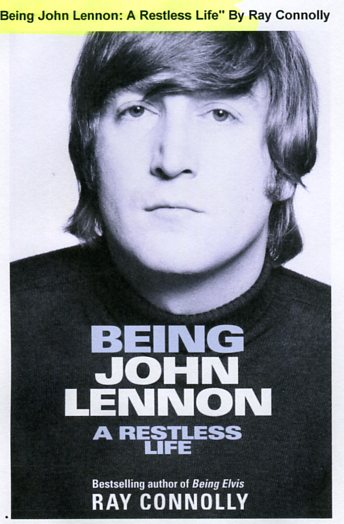

How John Lennon became mesmerized by Yoko Ono
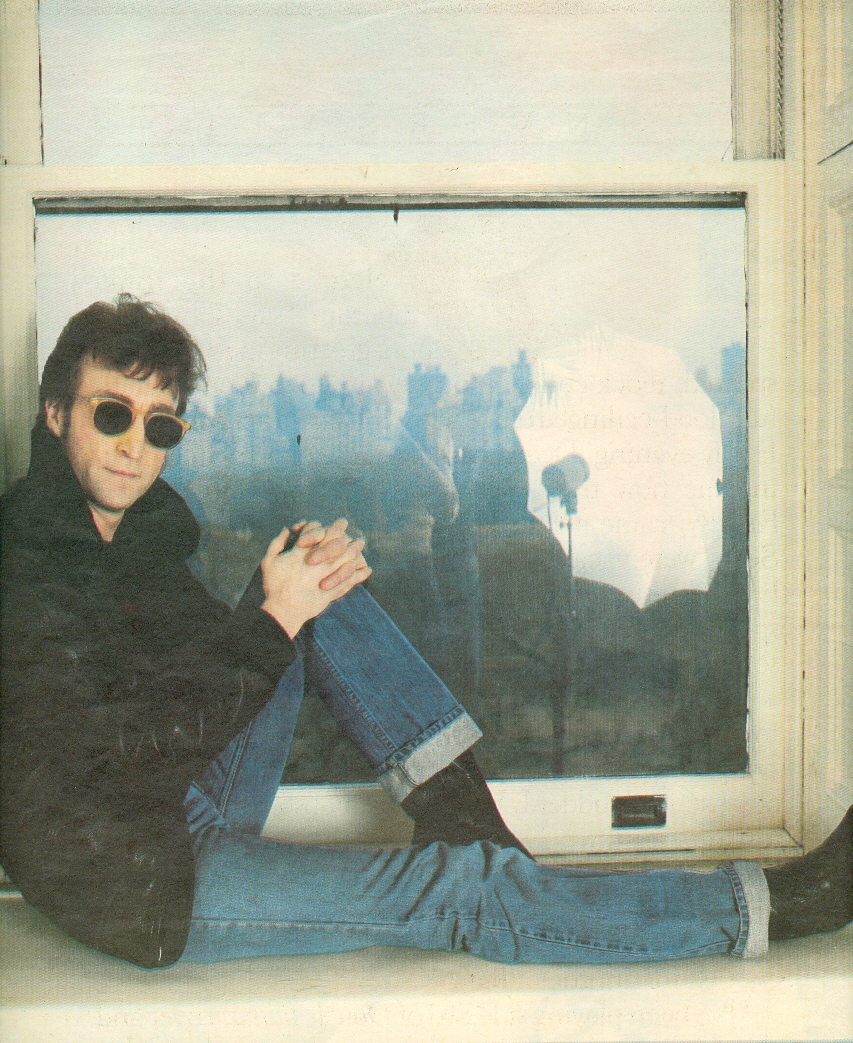
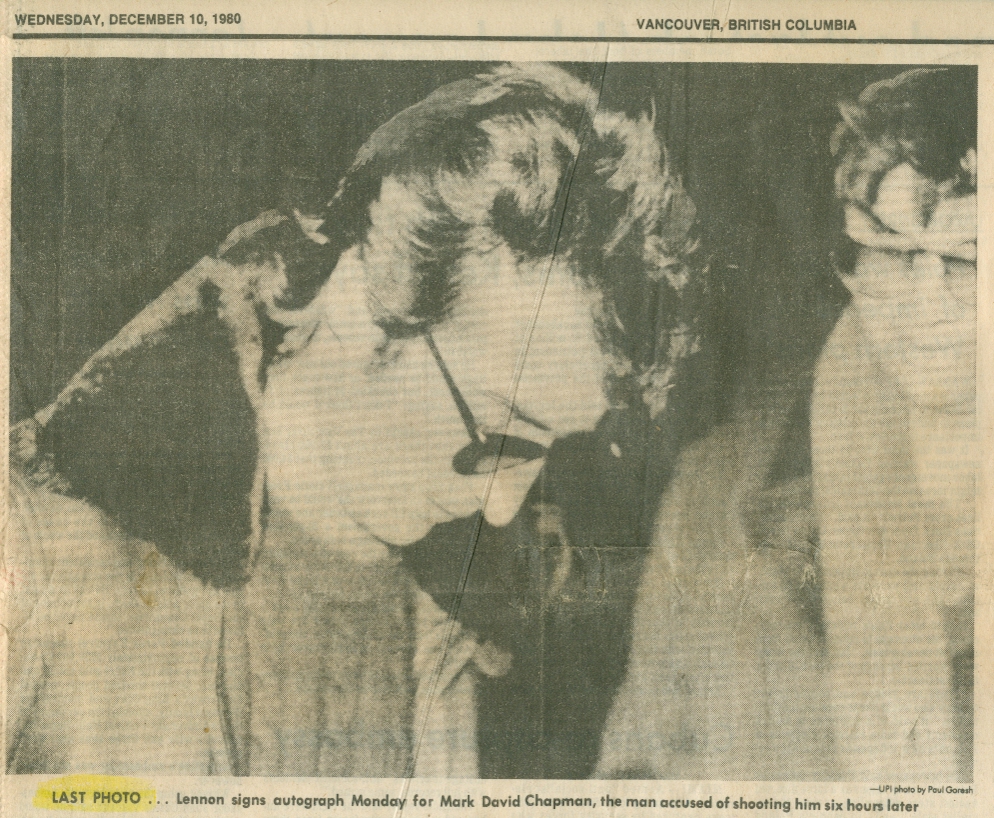
THE DAY THE LENNON MUSIC DIED
& LENNON'S DARK FATE ONO
& IMAGINE THERE'S NO YOKO
& Old World Destruction
Cops picked up bloody guy/drove to hospital (didn't know it was Beatle Lennon in backseat), NewYorkDailyNews, Dec 9, 2014
The day John Lennon died: Jimmy Breslin writes iconic tale of NYPD cops who drove the dying Beatles star to the hospital
This is the column written by Jimmy Breslin on December 9, 1980, recounting the moment officers found the legendary Beatles singer wounded and transported him in the back of a patrol car to Roosevelt Hospital, all the while not knowing who he was...)
 Lennon's Murder: The Crime Scene (John Lennon was shot and killed on December 8, 1980, at about 10:50pm as he and his wife Yoko Ono attempted to enter the Dakota building on West 72nd Street in Manhattan across from Central Park West...)
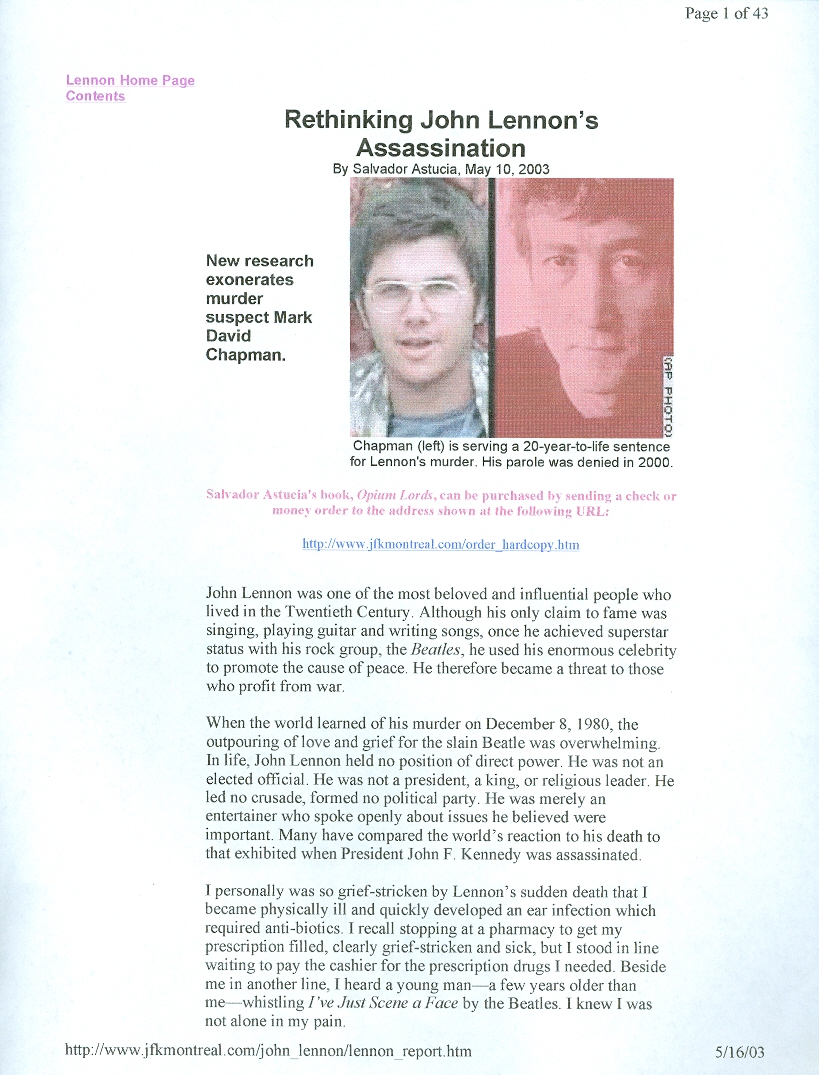

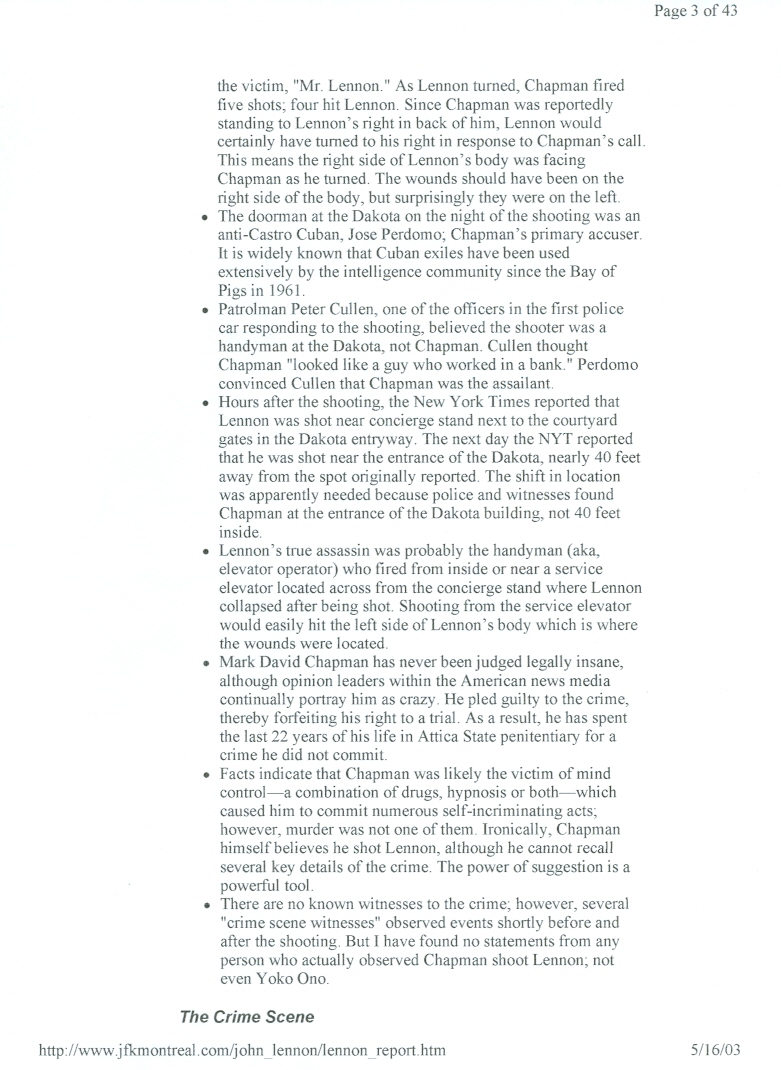
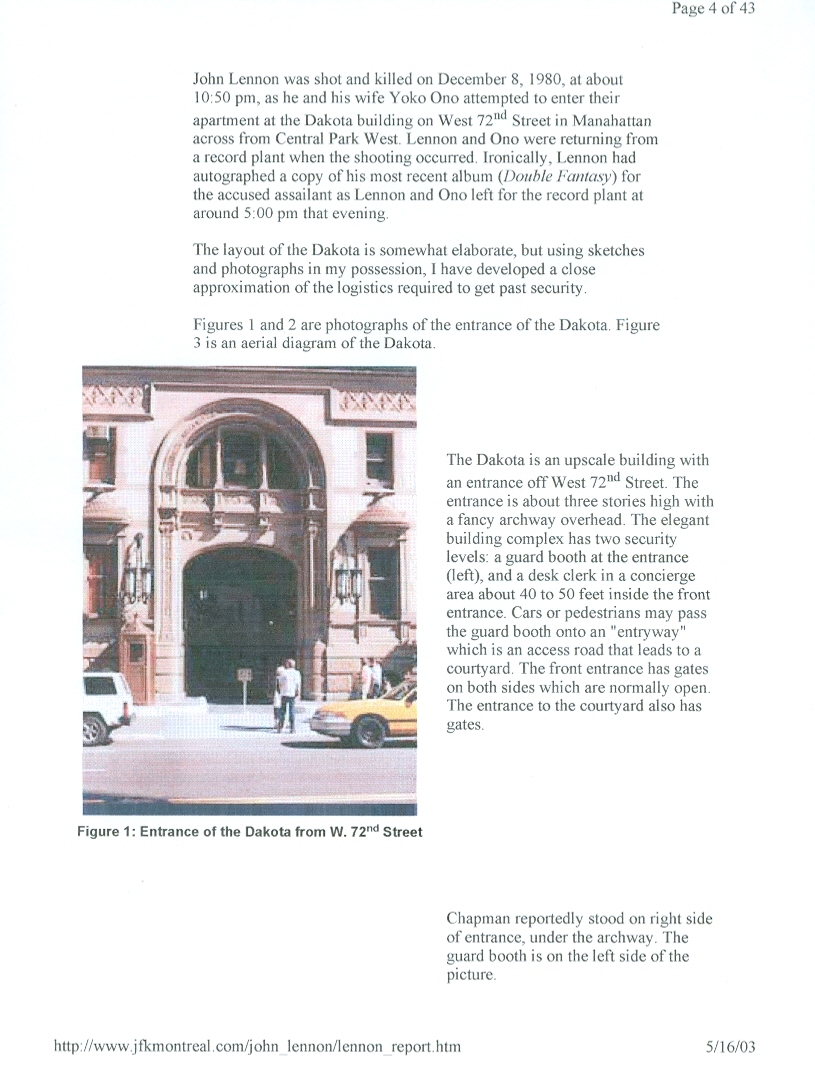

 Rethinking John Lennon's Assassination, by Salvador Astucia, May 10, 2003
 Beatles books owned by Jackie Jura
Reader describes how Yoko got John back from May Pang
Reader likes the new "Imagine" lyrics but says Paul wasn't in cahoots with Yoko
9/11 ADDS UP AGAIN (...I notice as well that 72nd is the same street as the Dakota building is on, which is where John Lennon lived and was shot in another New York dastardly deed. John Lennon would have turned 66 on Monday October 9th, 2006. And the news of his alleged assassin's parole verdict was announced on Wednesday, October 11th, the same day as the airplane crashed into the 72nd Street building....)
When John Lennon met Yoko Ono (On 9 November 1966 [9/11/1666], after he had just finished filming How I Won the War, Lennon visited an art exhibit of Yoko Ono's at the Indica gallery in Mason's Yard, London. There, John asked if he could be the first to 'interact' with one of her installations by hammering a nail into a blank wooden block. She tells Young she refused because the exhibition had not opened to the public and then relented. John on meeting Yoko: She handed him a card with the word "breathe" on it and I said "you mean (panting)?" She says "That's it, You got it". And I'm thinking "I've got it it!" But I'm all geared up to do something". It was another piece that cemented his feeling for Yoko.)
On December 8th, 2005 - the 25th anniversary of the assassination of John Lennon - the coverage of the event in one of Canada's national newspapers, the National Post, consisted of a two-foot by 1-foot full page picture of Yoko Ono's display of John Lennon's blood-spattered glasses. I was shocked when I turned the page and came across this cruel visage and wondered why the space hadn't been taken up with pictures and stories of John Lennon. Ideally I'd have liked to have seen a chronological list of the Beatles songs, along with photos of them and the albums. That would have been informative, interesting and would also have provided a trip down memory lane for people who experienced Beatlemania. ~ Jackie Jura
Lennon had no desire to be a leader (because, in his words, "leaders get killed"). Roanoke Times, Dec 8, 2005. "I read the news today, oh boy."
Ono joins Dakota vigil for John (murdered there in her presence). CNN, Dec 8, 2005
Ono, dressed in black and wearing large sunglasses...escorted to the memorial by New York City police...spent several minutes looking at flowers and messages placed at the "Imagine" mosaic that is the centerpiece of "Strawberry Fields," a section of Central Park across the street from her apartment building. "That's the first time I've seen her come" said one man who had visited Strawberry Fields every year since Lennon's death....Friends of Lennon remembered the person, not just the legend. "You couldn't approach John at the end, and looking back it was from the moment he met Yoko Ono," former friend and fellow musician Billy Kinsley told Reuters...)
JOHN'S DAKOTA HOME OF ROSEMARY'S BABY The Dakota Building on Manhattan's Upper West Side was renamed The Bramford for the 1968 film Rosemary's Baby. It was on the set of this film that Mia Farrow received divorce papers from then-husband Frank Sinatra. There is a popular rumor that Church of Satan founder Anton LaVey gave technical advice and portrayed Satan in the impregnation scene. This is false - LaVey had no involvement with the film. Directed by Roman Polanski, whose pregnant wife, the actress Sharon Tate, was in 1969 murdered by Charles Manson and his followers, who titled their death spree "Helter Skelter" after the 1968 song by The Beatles, whose leader, John Lennon, who would one day live (and in 1980 be murdered) in the Manhattan apartment building called The Dakota - where Rosemary's Baby had been filmed...
Doctor held heart in hands. Indystar.com, Dec 9, 2005 (...He had been called to treat a man with three gunshot wounds to the chest..."When someone said it was John Lennon, I thought it was a bad joke. But then they found his ID in his pocket...")
Doctor remembers Lennon's death (bloody linens & uniforms destroyed; medical record placed in vault). KAIT/K8, Jonesboro, AR, Dec 6, 2005
Yoko's iron grip on Lennon legacy ('doesn't belong to world any more'). BBC, Dec 7, 2005 & Yoko denies musical hi-jack (only original Beatles song is Ballad of John & Yoko). London Times, Aug 16, 2005
Yoko chose mistress for John (later married Paul's producer). London Times, July 24, 2005
In Broadway musical about the life of John Lennon "There is too much Yoko telling John, 'I told you so'. It makes you think Yoko really did break up the Beatles."...
* John Lennon & Yoko Ono Filmography...Yoko Ono (1965-67)
Satan's Bed: Around the time the Beatles filmed Help!, Yoko was given a part in this sleazy adults-only S+M drug movie by Roberta and Michael Findlay (SNUFF). Michael was the photographer and editor, Roberta acted and was responsible for the lighting. Satan's Bed was really an updated version of an earlier unfinished feature called Judas City by "Tamijian" with the new footage and characters edited in. Interwoven with the Judas City scenes is the sick tale of Snake, Dip and Angel, addicts in black clothes (not dissimilar to Andy Warhol's Exploding Plastic Inevitable show crowd), they roam around tying up women and raping them. Yoko (in a kimono) shows up in New York to marry Paulie, who wants out of the drug business, she can't speak English and he is preoccupied, so she's taken to a filthy cheap hotel room. A gangster (in the concrete business) rapes her on the floor (off screen), he then takes her to his penthouse and rapes her again. Finally a Long Island housewife with a gun escapes from the doped up trio and footage of Yoko escaping is intercut.
One: Yoko had begun making minimalist films in New York as a member of a group of conceptual artists called Fluxus. One was a five-minute short which featured a slow-motion sequence of a match being struck.
Four: Four was another five-minute short which this time featured close-up studies of 15 bare bottoms in motion as they walked on a treadmill, the subjects of the film included Yoko, her husband Tony Cox and their daughter Kyoko. It was premiered at the Film-Maker's Cinematheque, New York on 6th February 1966.
Bottoms: 1967 was the year in which Yoko Ono first hit the headlines in Britain and it was there that she made a longer re-make of Four, more commonly known as "Bottoms". Yoko asked 364 people associated with the swinging London scene to expose their backsides for the film which was produced by Tony Cox, this version also included a soundtrack (interviews with the subjects). It was premiered at the Jacey Tatler Cinema in London on 8th August 1967.
WITCHES, WIZARDS & DEMONS and BYE, BYE APPLE PIE
JOHN LENNON'S HOMES (John was introduced to Yoko by John Dunbar on the 9th November 1966 at the Indica Gallery at 6 Mason's Yard off Duke Street...)
Drug-inspired Lennon drawings unearthed. Reuters, Oct 26, 1996
The man who introduced John Lennon to Yoko Ono is reported to have found a collection of drug-fuelled drawings done by the late Beatles star on a "magical mystery tour" to an Irish island he wanted to buy...He said the two had taken the drug LSD. "I had taken it first as early as 1963 whereas John had only recently started so I think he was probably more affected by it," he added.
Biography: Behind the Music. USA Today, May 3, 1999
Julian feels abandoned because his dad left when he was 3. He's also mad at his dad's second wife, who he says is cheating him out of his inheritance. Julian tried his dad's business but felt used by greedy associates. Now, he's trying again...
Julian Speaks Out, December 2000 (20th anniversary of Father's death)
...Once I began to look at his life and really understand him, I began to feel so sorry for him, because once he was a guiding light, a star that shone on all of us, until he was sucked into a black hole and all of his strength consumed. Although he was definitely afraid of fatherhood, the combination of that and his life with Yoko Ono led to the real break down of our relationship. We did not see each other for extended periods of time and as the saying goes, out of sight, out of mind! But the Beatles themselves played no part whatsoever in our demise...
Doctor remembers Lennon's death (bloody linens & uniforms destroyed; medical record placed in vault). KAIT/K8, Jonesboro, AR, Dec 6, 2005
Photo of Lennon's blood-spattered glasses (copies given to close friends and Ono kept one for herself, which was later used on the front cover of her album Seasons of Glass). BBC, Apr 15, 2002
John Lennon shot dead. BBC, Dec 8, 1980
He was rushed in a police car to St Luke's Roosevelt Hospital Center, where he died. His wife, Yoko Ono, who is understood to have witnessed the attack, was with him. Witness reports say at least three shots were fired and others have claimed they heard six. There are also reports Mr Lennon staggered up six steps into the vestibule after he was shot, before collapsing.
Jackie Jura
~ an independent researcher monitoring local, national and international events ~
email: orwelltoday@gmail.com
HOME PAGE
website: www.orwelltoday.com
